Your shopping cart is empty!


MENU
Your shopping cart is empty!
Wall panels can transform a plain interior quickly, but the quality of the finished installation depends heavily on what is behind the panel. A fixing method that works well on a sound plastered wall may fail on dusty gypsum, uneven masonry or glossy ceramic tiles.
For homeowners, contractors and interior designers looking for wall panel adhesive in Kenya, the key is to match the fixing method to the substrate, panel material, panel weight and conditions of the room. Adhesive selection is only one part of the process; surface preparation, alignment, curing and mechanical support can be equally important.
Ali Glaziers Flooring Solutions supplies interior finishing products alongside hardware and building materials for projects in Nairobi, Eastleigh, Malindi and across Kenya. Before beginning an installation, buyers can explore the Ali Glaziers product range and confirm the latest product specifications and availability.
The substrate determines how well an adhesive or mechanical fixing can grip the wall and support the panel over time. A clean, dry, stable and suitably prepared substrate is essential whether panels are being installed on gypsum, plaster, masonry or existing tiles.
A wall panel does not simply adhere to "the wall." It adheres to the surface layer of that wall.
That distinction matters.
A plastered wall may have a strong underlying masonry structure but a weak layer of dusty paint on its surface. A gypsum partition may be structurally sound but unable to support certain heavy loads without fixing into studs or framing. A tiled wall may be solid but covered with a glossy surface that provides poor adhesion for an unsuitable adhesive.
Before purchasing a wall panel adhesive in Kenya, identify the actual surface onto which the adhesive will bond.
Common interior substrates include:
Each requires a slightly different preparation approach.
The panel itself also matters.
PVC fluted panels, WPC panels and PU decorative panels can differ in weight, rigidity, surface construction and recommended fixing method. Therefore, there is no single adhesive that should automatically be used for every wall panel installation.
The best fixing method is the one specified for the particular panel and compatible with the substrate, with construction adhesive commonly used for suitable lightweight decorative panels and mechanical fixing used where additional support is required. Heavy panels, unstable substrates and demanding installations may require a combination of adhesive and mechanical fixing.
There are three broad approaches:
Adhesive fixing provides a clean installation without visible screws across the face of the panel.
It is particularly attractive for decorative interior applications because the finished surface can remain visually uninterrupted.
However, adhesive only works reliably when the substrate is suitable.
Mechanical fixing uses screws, anchors, clips or another physical fastening system.
It may be appropriate when:
Using adhesive together with mechanical support can provide additional security where the installation conditions justify it.
However, the fixing system should be designed rather than improvised. Using random screws or unsuitable anchors can damage the panel or substrate.
Lightweight decorative panels can often be fixed to sound gypsum board using a compatible adhesive, but the gypsum surface must be clean, dry and firmly bonded. For heavier panels or installations subject to additional loads, fixings should engage suitable framing or structural support rather than relying solely on the gypsum face.
Gypsum board is common in modern offices, apartments, hotels and commercial interiors.
It provides a relatively smooth surface, which can be advantageous for decorative panel installation.
However, gypsum is not the same as masonry.
The face of the board has a paper layer, while the board itself has limited capacity for certain types of concentrated loading. This becomes important when installing heavy materials.
Before installing a decorative panel:
If the gypsum wall has recently been installed, allow jointing compounds, primers and other coatings to cure according to their product requirements before applying the panel.
Paint can either provide a suitable bonding surface or create a failure point.
If the paint is firmly bonded, clean and compatible with the selected adhesive, installation may be possible.
If the paint is peeling, chalking or poorly bonded, applying adhesive over it simply transfers the weakness to the panel.
The adhesive may bond strongly to the paint while the paint itself separates from the gypsum.
This is one of the most common principles in adhesive installation:
The weakest layer determines the practical strength of the bond.
Sound cement-plastered walls are generally suitable for adhesive installation when the surface is clean, dry, stable and reasonably smooth. Dusty, powdery, damp or badly uneven plaster should be repaired or prepared before panels are installed.
Plastered masonry is one of the more common interior substrates in Kenya.
The challenge is that plaster quality varies considerably from one building to another.
A newly plastered wall may contain fine dust on the surface. An older wall may have several layers of paint. Some surfaces may also have minor cracks, loose areas or uneven patches.
Before applying adhesive, rub the surface with your hand.
If significant powder comes away, the surface needs preparation.
Also look for:
These conditions should be corrected before panel installation.
An adhesive can compensate for small variations depending on the product and application method.
It cannot reliably turn a severely uneven wall into a perfectly flat installation without appropriate preparation.
When a rigid panel is installed over significant high and low points, several problems can occur:
Where necessary, the wall should be levelled or locally repaired before installation.
Concrete and block walls provide strong substrates when they are structurally sound, but their surfaces must be clean and sufficiently stable for adhesive or anchor installation. Porous masonry may require appropriate preparation or a compatible primer, while mechanical anchors must match the masonry type.
Concrete and blockwork can provide a robust base for interior panels.
However, concrete and masonry are not automatically perfect bonding surfaces.
Dust from drilling, laitance, loose mortar, old paint and surface contamination can reduce adhesion.
For mechanical fixing, the type of masonry also matters.
A fixing suitable for solid concrete should not automatically be assumed to be suitable for hollow blocks.
The general preparation sequence includes:
This last step is particularly important.
Never drill blindly into a wall without considering concealed electrical cables and plumbing.
Wall panels can sometimes be installed over existing ceramic or porcelain tiles when the tiles are firmly bonded, clean and compatible with the selected fixing system. Glossy, greasy, loose or heavily contaminated tiles may require mechanical preparation, priming or removal before reliable bonding is possible.
Installing panels over existing tiles can save demolition time and reduce dust.
It can also be useful when renovating:
But the existing tile surface must be assessed first.
Tap or inspect the existing tiles for loose sections.
A panel fixed to a loose tile is not a secure installation.
The adhesive may bond to the tile perfectly, but the tile itself can still detach from the substrate.
Kitchen tiles may have grease.
Bathroom tiles may have soap deposits.
Both can interfere with adhesion.
The surface must therefore be cleaned using a method appropriate to the existing tile and adhesive system.
Glossy porcelain and ceramic surfaces may provide less mechanical key than a suitably prepared matt surface.
Depending on the adhesive system, the surface may need suitable preparation or primer.
Do not automatically sand or chemically treat tiles without checking the manufacturer's recommendations for both the tile and the adhesive.
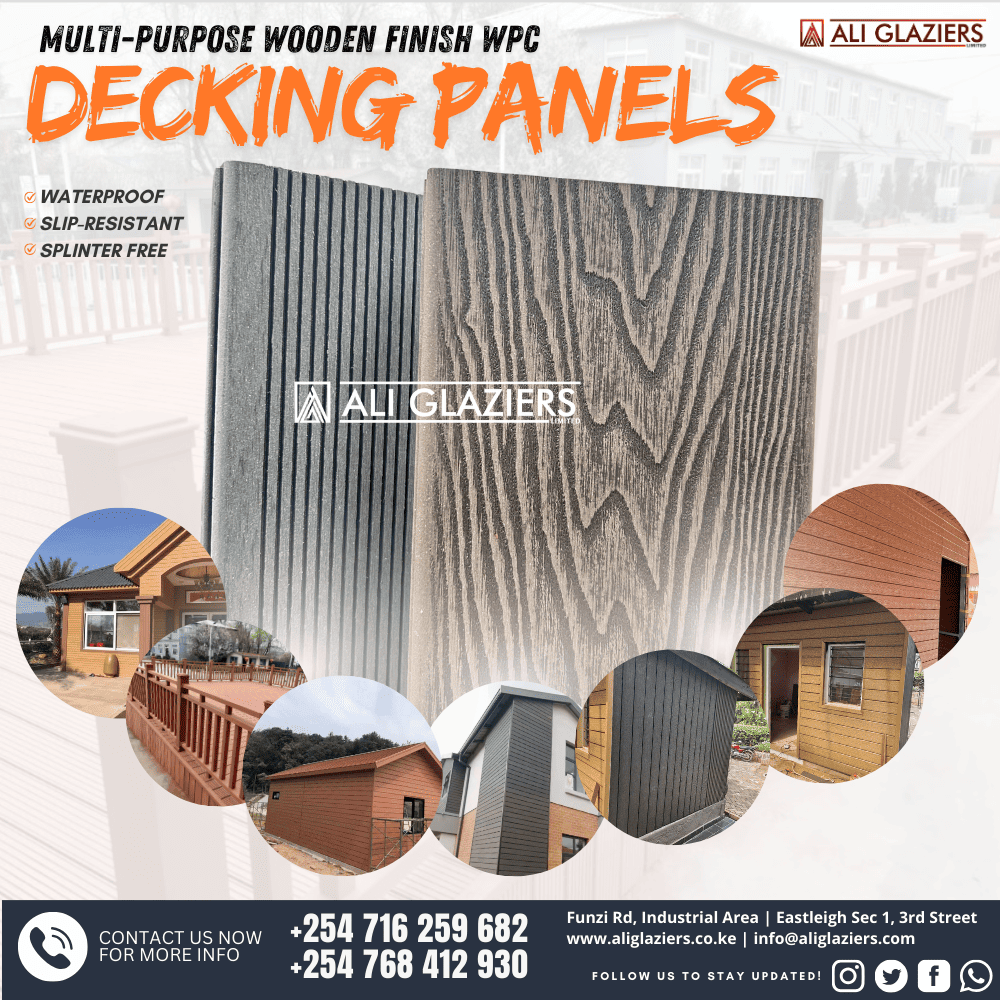
Suitable WPC decorative panels can be adhesive-fixed when the adhesive is compatible with both the WPC surface and the substrate. Larger or heavier WPC installations should be assessed for additional mechanical support and should follow the specific product manufacturer's fixing instructions.
WPC, or Wood Plastic Composite, is increasingly used for contemporary interiors because it can provide a wood-inspired decorative appearance with engineered material characteristics.
A fluted WPC panel may be installed vertically to create:
The weight and construction of the particular WPC product determine the fixing requirements.
A solid WPC panel should not automatically be treated like a lightweight hollow decorative panel.
When purchasing, confirm:
Ali Glaziers' catalogue includes decorative WPC products as part of its broader building-material selection. Buyers can search the current catalogue by product requirements before selecting a panel and fixing system.
Use an adhesive specifically rated as compatible with the panel material and the substrate rather than choosing solely on strength or price. Construction adhesives, hybrid polymer products and other panel adhesives may be appropriate for different applications, but the manufacturer's compatibility and curing requirements should be followed.
The term "strong adhesive" is not enough.
An adhesive needs to perform under the conditions of the installation.
Important characteristics include:
Two tubes can look similar while being designed for completely different applications.
Do not assume that an adhesive used for timber, tiles, metal or general construction is automatically appropriate for a particular PVC, WPC or PU panel.
Read the product technical information.
If uncertain, provide the supplier with the exact panel material and substrate and ask for confirmation.
Wall panels most commonly fail because of poor surface preparation, incompatible adhesive, moisture, unstable paint or plaster, insufficient adhesive coverage, incorrect curing conditions or an unsuitable substrate. The panel itself may not be the problem when the underlying surface or fixing system is inadequate.
Understanding failure points helps prevent expensive rework.
Dust prevents the adhesive from bonding directly to the substrate.
Instead, the adhesive bonds to loose particles.
When those particles detach, the panel follows.
Moisture can weaken certain adhesives and cause deterioration of the substrate.
A decorative panel should never be used to conceal an unresolved leak.
If paint is peeling, the adhesive cannot overcome the weakness.
The paint becomes the failure layer.
An adhesive may be strong but chemically incompatible with the panel.
Insufficient coverage can leave unsupported areas.
Poor bead placement or excessive spacing can reduce the effective bonding area.
Some adhesives need the panel to remain in position until adequate initial bond strength develops.
Large gaps between panel and wall can prevent consistent adhesive contact.
Wrong anchors can pull out, damage the substrate or crack the panel.
Adhesive curing can be affected by environmental conditions.
This is particularly relevant across Kenya's different climatic zones.
Wall-panel installation should account for local humidity, temperature variation and moisture exposure, particularly in coastal locations such as Malindi. Moisture-resistant materials can improve suitability in humid interiors, but correct substrate preparation, ventilation and moisture control remain essential.
Kenya does not have one uniform indoor environment.
A Nairobi apartment, an Eastleigh commercial building and a Malindi coastal property can experience very different humidity conditions.
Nairobi's generally cooler highland environment can provide relatively stable indoor conditions, but kitchens, bathrooms and poorly ventilated rooms may still have elevated moisture.
Coastal properties can experience higher humidity.
This makes substrate moisture and ventilation particularly important.
A WPC or suitable PVC decorative panel may be attractive in such environments because certain products offer strong moisture-resistant characteristics.
However, moisture resistance of the panel does not mean the entire wall assembly is waterproof.
If a wall is damp because of:
the source should be corrected first.
Painted walls can accept decorative panels when the paint is firmly bonded, clean and compatible with the selected adhesive. Peeling, chalking, greasy or weak paint should be removed or properly prepared before panel installation.
Paint is often the hidden variable in wall-panel installations.
A wall can appear perfectly smooth while having a weak surface layer.
Visually inspect the paint.
Then assess whether it is:
Any significant defect should be addressed.
For high-value commercial projects, substrate preparation should be treated as part of the installation specification rather than an optional extra.
Proper preparation involves inspecting the substrate, removing dust and unstable finishes, correcting moisture problems, repairing defects and confirming that the surface is compatible with the fixing system. Spending more time on preparation generally produces a more reliable and cleaner finished installation.
A practical preparation sequence is:
Measure the wall width and height.
Account for:
Identify the substrate.
Look for dampness, staining or other evidence of water problems.
Remove loose paint, plaster and other unstable layers.
Remove dust, grease and contaminants.
Fill or level significant defects where necessary.
Dry-fit or mark panel positions before applying adhesive.
Follow the panel and adhesive manufacturer's instructions.
Start with a properly levelled reference line and use accurate measurements throughout installation to keep fluted panels vertically aligned. Small errors become increasingly visible because the repeated grooves create continuous lines across the wall.
Fluted panels are less forgiving of poor alignment than some random-pattern decorative panels.
If the first panel is slightly out of vertical, the error can become obvious across the entire feature wall.
Use:
Do not assume that the ceiling or floor is perfectly level.
Buildings can contain small variations.
The installation should therefore be planned around a reliable reference line rather than simply following an uneven ceiling or floor.
Screws or other mechanical fixings may be appropriate when the panel, substrate or installation conditions require additional support, but the fixing must be selected for the specific substrate and panel. Visible mechanical fixings should also be planned so they do not compromise the finished appearance.
Mechanical fixing can be particularly useful when:
However, drilling holes without understanding the substrate is not professional installation.
For gypsum, identify studs or suitable framing where required.
For concrete, use compatible anchors.
For blockwork, select fixings appropriate to the type of block.
For tiled surfaces, avoid damaging concealed services and assess whether fixing through the tile is actually necessary.
Adhesive and mechanical fixing can be combined where the product and substrate justify a hybrid installation method. This approach can provide immediate positioning support and long-term security, but both systems must be compatible with the panel and substrate.
Combination fixing can be useful for larger installations.
For example, adhesive can provide distributed contact across the back of a panel while strategically positioned mechanical fixings provide additional retention.
However, the fixing points should be carefully planned.
Improvised fastening can cause:
For decorative installations, mechanical support should be designed around the final appearance.
Before buying, confirm the panel's material, dimensions, thickness, weight, substrate compatibility and recommended installation method. Also establish whether the project requires adhesive, mechanical fixing or a combination before ordering the full quantity.
A professional buyer should ask the supplier:
These questions are more useful than simply asking, "What is the price per panel?"
Wall panels should be specified using their actual material, dimensions and thickness rather than applying flooring-only terminology to decorative wall products. Wear-layer grades such as AC4 are generally relevant to laminate flooring and should not be assigned to wall panels unless the manufacturer specifically classifies the product that way.
For a project specification, use a table such as the following and confirm the exact product data before purchase:
| Panel Type | Example Plank/Board Dimensions | Thickness | Wear Layer Grade | Fixing Consideration |
|---|---|---|---|---|
| PVC fluted panel | 170 mm × 2.8 m | Confirm selected product | N/A | Compatible adhesive or specified mechanical fixing |
| PVC fluted panel | 170 mm × 2.9 m | Confirm selected product | N/A | Substrate-dependent |
| PVC fluted panel | 200 mm × 2.9 m | Confirm selected product | N/A | Substrate-dependent |
| Solid WPC fluted panel | 118 mm × 2.5 m | Confirm selected product | N/A | Adhesive and/or mechanical support according to product |
| PU stone finish 3D panel | Product-specific | Confirm selected product | N/A | Follow product-specific installation system |
These dimensions illustrate why the exact product should be confirmed before calculating quantities.
A 170 mm × 2.8 metre panel provides different coverage from a 200 mm × 2.9 metre panel.
Similarly, a solid WPC panel should not automatically be compared with a lightweight PVC panel based only on its visual appearance.
If flooring is being installed alongside the wall panels, flooring specifications should be recorded separately, including plank dimensions, thickness and wear classification where applicable. Buyers can explore the broader flooring and building-material categories when planning the complete project.
Adhesive consumption depends on the adhesive type, substrate condition, panel size, application pattern and manufacturer's recommended coverage. Do not estimate adhesive solely from the number of panels; calculate it using the manufacturer's stated coverage and the actual wall conditions.
Coverage can vary significantly.
A smooth wall may require a different application approach from a slightly uneven surface.
Likewise, a larger panel may need a different adhesive pattern from a narrow decorative strip.
Excessive adhesive is not automatically better.
Too little can create insufficient contact, while too much may increase curing time, create unevenness or squeeze out at panel joints.
Follow the adhesive manufacturer's application instructions.
Corners and exposed edges should be planned before installation because cutting and finishing can determine whether the completed feature wall looks professional. Measure around doors, windows, sockets and corners rather than treating them as last-minute adjustments.
Corners are often where installation quality becomes visible.
Before fixing panels, decide:
The same applies to electrical sockets.
A socket should not simply be cut around after the panel is fixed.
Its position should be measured and transferred accurately to the panel before cutting.
The most avoidable installation mistakes are poor substrate preparation, incorrect adhesive selection, inaccurate measurement, ignoring moisture, inadequate support and poor alignment. Correcting these issues before installation is considerably easier than removing and replacing a failed feature wall.
Watch for these common errors:
This hides rather than solves the moisture problem.
Dust reduces bond strength.
The paint becomes the weak layer.
Compatibility matters.
The final panel may end up as an awkward narrow strip.
Drilling without checking concealed services creates unnecessary risk.
The substrate may not provide adequate support.
Panels can shift before the adhesive develops sufficient strength.
A generic installation technique may not suit the exact panel.
Professional installation is recommended when panels are heavy, the substrate is uneven or uncertain, the wall contains complex electrical services, or the finished alignment must meet a high commercial standard. Professional preparation can also reduce material wastage and prevent adhesive and substrate failures.
Professional installation is especially worthwhile for:
The cost of installation should be considered alongside the cost of replacing failed panels.
A poorly prepared wall can turn an apparently inexpensive DIY installation into a costly repair.
Wall and floor finishes should be selected together so their colours, textures and patterns complement one another. A heavily textured wall panel usually works best with a relatively controlled flooring pattern, while a quieter wall can support more visual character in the floor.
For example:
Fluted wall + wood-look SPC
Creates a contemporary, warm interior.
Fluted wall + neutral vinyl
Allows the wall to become the primary feature.
WPC wall + laminate flooring
Can produce a coordinated wood-inspired aesthetic when tones are deliberately selected.
3D stone-effect wall + neutral floor
Allows the wall texture to become the main visual statement.
Ali Glaziers supplies flooring alongside interior finishing materials, making it practical to consider the two surfaces together. Buyers can browse the wider product catalogue before finalising their design.
A wall-panel project may require more than panels and adhesive, including trims, cutting tools, measuring equipment, suitable anchors, primers and finishing materials depending on the substrate. Planning these items in advance reduces installation delays and improvised fixing methods.
A project may require:
The exact list depends on the panel and installation environment.
Ali Glaziers also supplies broader hardware and building materials, allowing customers to source related project requirements. You can browse hardware-related products or explore adhesives when preparing an installation.
Some wall panels are suitable for moisture-prone interiors, but suitability depends on the specific material, installation system and location. Waterproof or moisture-resistant characteristics of a panel do not eliminate the need for proper waterproofing, ventilation and substrate preparation.
Bathrooms, kitchens and coastal interiors require additional consideration.
For wet areas, confirm:
Avoid assuming that a panel described as "water-resistant" is suitable for continuous direct water exposure.
The distinction between water-resistant and waterproof can be important.
Business customers should retain proper tax documentation for qualifying purchases, and Ali Glaziers provides eTIMS-compliant invoices to support business record-keeping in 2026. This is particularly relevant for contractors, developers, offices, hospitality businesses and other commercial buyers.
A wall-panel purchase may form part of a larger commercial project.
Proper documentation helps businesses maintain their purchase records and supports appropriate accounting and tax processes.
Commercial customers should provide the correct business details when ordering and retain their eTIMS documentation.
This becomes especially useful when a project includes multiple material categories such as:
Businesses can learn more about Ali Glaziers and its broader product offering when evaluating a supplier for a larger renovation or construction project.
Lightweight panels can often be adhesive-fixed to sound gypsum board when the adhesive is compatible and the surface is properly prepared. Heavy panels may require fixing into studs or another suitable structural support.
Yes, provided the paint is firmly bonded, clean, dry and compatible with the fixing system. Peeling, chalking or weak paint should be removed or repaired first.
Existing tiles can sometimes provide a suitable substrate when firmly bonded and properly cleaned and prepared. Glossy or contaminated tiles may require additional surface preparation or a compatible primer.
The choice depends on the panel and substrate. Adhesive can provide a clean decorative installation for suitable products, while mechanical fixing or a combination may be appropriate for heavier panels or demanding substrates.
Panel failure is commonly linked to poor substrate preparation, moisture, incompatible adhesive, weak paint or plaster, insufficient bonding or incorrect installation. Identify the failure layer before simply applying more adhesive.
WPC can be a practical decorative option for coastal interiors because many WPC products offer moisture-resistant characteristics. The wall must still be dry, properly prepared and protected from unresolved water penetration.
Simple lightweight panel installations may be suitable for experienced DIY users, but professional installation is preferable for large, heavy, complex or high-value projects. Accurate substrate preparation and alignment are critical to the final result.
Curing time varies according to the adhesive, temperature, humidity, application thickness and substrate. Follow the adhesive manufacturer's stated curing and handling times rather than assuming that the panel is fully bonded immediately after installation.
The most important part of wall-panel installation is not the decorative panel itself but the substrate and fixing system supporting it. Identify the wall material, correct moisture and surface defects, select a compatible adhesive or mechanical fixing and carefully plan alignment before installation begins.
For wall panel adhesive in Kenya, avoid choosing a product simply because it claims to be "extra strong."
The correct question is:
Is this adhesive compatible with my panel, my substrate and my installation conditions?
A good installation begins with the wall.
On gypsum, assess whether the panel weight is appropriate and whether fixings need to engage studs.
On plaster, remove dust and weak finishes.
On concrete and blockwork, prepare the masonry and select appropriate anchors where mechanical fixing is required.
On existing tiles, check that the tiles are firmly bonded and properly cleaned.
In humid areas such as Malindi, pay particular attention to moisture.
For fluted panels, take additional care with vertical alignment because repeated grooves make installation errors easy to see.
And for commercial buyers, retain eTIMS-compliant invoices from Ali Glaziers for appropriate business record-keeping.
The goal is not merely to make a panel stick to a wall.
The goal is to create a stable, accurately aligned and durable interior finish that remains attractive after installation.
Ali Glaziers Limited is a one-stop hardware and flooring shop supplying wall finishes, flooring, hardware and related building materials for residential and commercial projects.
Nairobi – Funzi Road: +254 716 259682
Eastleigh Branch: +254 722 522452 | +254 723 354299
Malindi Branch: Imadi Shopping Mall | +254 722 671352
Email: [email protected]
Website: Visit Ali Glaziers online
Delivery: Same-day delivery in Nairobi and next-day delivery to Mombasa, Kisumu, Eldoret, Nakuru and beyond, subject to product availability and delivery arrangements.
Whether you are installing a fluted WPC feature wall in Nairobi, renovating a commercial interior in Eastleigh or upgrading a coastal property in Malindi, contact Ali Glaziers for product guidance before purchasing your panels and fixing materials.


-250x250.png)